
Introduction
Managing employees effectively is one of the most important responsibilities for any organization. As businesses grow, handling payroll, human resources, employee benefits, time tracking, compliance, and workforce administration can become increasingly complex. For many organizations, using specialized technology can make these processes more efficient and easier to manage.
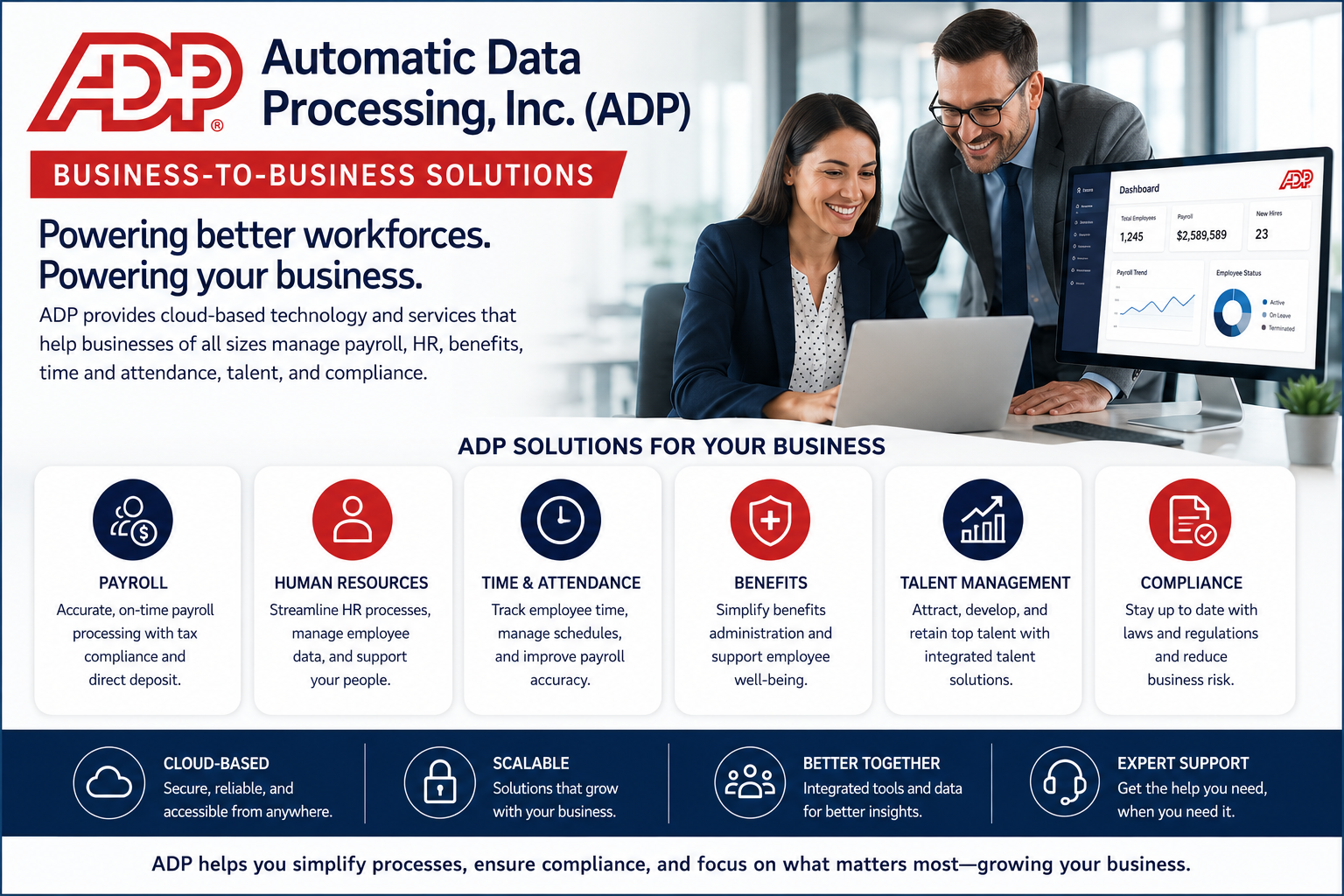
Automatic Data Processing, Inc. (ADP) Business-to-Business provides technology and services designed to help organizations manage these important workforce functions. ADP is widely recognized as a provider of payroll and human capital management solutions, supporting businesses of different sizes and across various industries.
Instead of relying on spreadsheets, manual calculations, disconnected systems, or multiple administrative processes, businesses can use ADP solutions to centralize and automate many workforce-related activities. This can help companies save time, improve accuracy, support employees, and allow management teams to focus on strategic business priorities.
This guide explains what Automatic Data Processing, Inc. (ADP) Business-to-Business means, the services ADP provides, the potential benefits for organizations, and the factors businesses should consider when evaluating workforce management technology.
What Is Automatic Data Processing, Inc. (ADP) Business-to-Business?
Automatic Data Processing, Inc. (ADP) is a business technology and services company that provides solutions for payroll, human resources, workforce management, talent management, benefits administration, and related business needs.
The term Automatic Data Processing, Inc. (ADP) Business-to-Business refers to the company’s services being primarily designed for organizations and employers. Rather than selling a simple consumer product, ADP provides businesses with tools and services that support the management of their employees and workforce operations.
These solutions can be used by small businesses with a limited number of employees as well as larger organizations with complex workforce structures. Depending on the organization’s needs, businesses can select solutions that support payroll, HR administration, employee benefits, time and attendance, recruitment, talent management, and other workforce functions.
The goal is to help organizations simplify administrative processes while providing employees and managers with access to useful workforce information.
Payroll Management and Automation
Payroll is one of the most important areas of business administration. Employees expect to be paid accurately and on time, while employers must manage deductions, tax-related responsibilities, employee records, and other payroll requirements.
ADP provides payroll solutions that can help organizations automate many payroll processes. Instead of manually calculating employee payments and maintaining multiple spreadsheets, businesses can use technology to organize payroll information and process payments more efficiently.
Automation can also reduce repetitive administrative work. When payroll information is connected with other workforce data, organizations can potentially reduce the need to enter the same information into different systems.
For businesses with growing teams, payroll automation can become particularly valuable. As employee numbers increase, payroll administration can require more time and attention. Technology can help businesses manage these processes in a more structured way.
Human Resources Management
Human resources departments are responsible for many activities beyond payroll. These may include employee records, onboarding, workforce policies, performance management, benefits, recruitment, and employee support.
ADP’s HR solutions are designed to help organizations manage these activities using digital tools. Centralizing employee information can make it easier for HR professionals and authorized managers to access relevant workforce data.
For example, an organization may need to update employee information, monitor workforce changes, manage onboarding activities, or maintain HR documentation. A centralized system can help reduce the administrative burden associated with managing these processes manually.
Effective HR technology can also support better organization. When information is stored systematically, HR teams can spend less time searching for records and more time focusing on employees and strategic workforce planning.
Time and Attendance Management
Tracking employee working hours can be challenging, particularly for businesses with large or distributed workforces. Different schedules, shifts, locations, and working arrangements can make manual time tracking difficult.
ADP provides workforce management tools that can support time and attendance processes. Businesses can use technology to manage working hours, schedules, attendance, and related workforce information.
Accurate time data can also support payroll processing. When employee hours are recorded consistently, organizations may have a clearer basis for calculating employee compensation.
For businesses that operate across different locations or have employees working different schedules, workforce management technology can provide a more organized approach to managing employee time.
Employee Benefits Administration
Employee benefits can play an important role in attracting and retaining workers. However, managing benefits can create significant administrative responsibilities for employers.
ADP offers solutions that can help organizations manage benefits-related processes and employee information. Depending on the solution and business requirements, organizations may use technology to support enrollment, employee communication, and benefits administration.
A structured benefits management process can also improve the employee experience. Employees need clear information about the benefits available to them and how to access or manage those benefits.
For employers, digital benefits administration can help reduce paperwork and make workforce information easier to manage.
Talent Management and Recruitment
Hiring the right employees is an important part of business growth. Organizations need processes for attracting candidates, managing recruitment, onboarding new employees, and supporting employee development.
ADP provides technology that can support aspects of talent management and workforce administration. Businesses can use digital tools to organize information related to employees and workforce activities.
Talent management can also extend beyond recruitment. Organizations may need to support employee performance, professional development, and workforce planning. Having structured systems can help management teams better understand their workforce and identify areas for improvement.
Workforce Data and Business Insights
Modern businesses increasingly rely on data to make informed decisions. Workforce data can provide valuable information about employee numbers, payroll costs, working hours, turnover, and other organizational factors.
One potential advantage of business-to-business workforce technology is the ability to organize this information in a way that supports analysis and decision-making.
For example, management may want to understand workforce costs, identify staffing trends, or evaluate changes in employee numbers. Having organized data can make these questions easier to investigate.
However, businesses should always ensure that workforce information is handled responsibly. Employee data can be sensitive, and organizations must follow applicable privacy, security, and regulatory requirements.
Benefits of Automatic Data Processing, Inc. (ADP) Business-to-Business Solutions
There are several potential advantages for organizations using ADP solutions.
1. Reduced Administrative Work
Automation can reduce repetitive manual tasks. Instead of managing every process manually, HR and payroll teams can use digital systems to organize and automate routine activities.
2. Improved Organization
Centralized workforce information can make it easier for businesses to manage employee records and administrative processes.
3. Scalability
A workforce system should be able to support a business as it grows. ADP offers solutions designed for organizations of different sizes, allowing businesses to choose services based on their workforce requirements.
4. Better Employee Access
Digital workforce systems can give employees access to relevant information and self-service features, depending on the solution being used.
5. More Efficient Payroll Processes
Payroll automation can help organizations manage payroll activities more systematically and reduce reliance on manual calculations.
6. Support for HR Teams
By automating routine processes, HR professionals can potentially spend more time on strategic activities such as employee engagement, workforce planning, and organizational development.
Who Can Use ADP Business-to-Business Solutions?
ADP’s business-to-business services can be relevant to a wide range of organizations.
Small Businesses
Small businesses often have limited administrative resources. Payroll and HR technology can help owners and managers organize employee-related responsibilities without relying entirely on manual processes.
Medium-Sized Businesses
As organizations grow, workforce administration becomes more complex. Medium-sized businesses may benefit from integrated payroll, HR, benefits, and workforce management solutions.
Large Enterprises
Large organizations may have thousands of employees across multiple locations. Managing payroll, HR, benefits, compliance, and workforce data at this scale requires structured systems and processes.
Organizations With Distributed Workforces
Businesses with employees working across different locations may also benefit from centralized workforce management technology.
Industries That May Benefit From ADP
Workforce management is important across almost every industry. ADP solutions can be relevant to organizations in areas such as retail, professional services, healthcare, manufacturing, hospitality, technology, education, construction, and other sectors.
Each industry has different workforce requirements. A business with hourly employees may have different needs from a professional services organization with salaried employees. Therefore, organizations should evaluate the specific features, integrations, pricing, and services available for their particular industry and workforce structure.
ADP and Business Efficiency
Business efficiency is not only about reducing costs. It also involves improving processes, reducing unnecessary administrative work, and allowing employees to focus on activities that create value.
When workforce administration is highly manual, HR teams may spend significant amounts of time handling routine tasks. Automated technology can help streamline these activities.
For example, a company may use separate spreadsheets for employee information, payroll calculations, time tracking, and HR records. Managing these systems separately can create duplication and increase the possibility of errors.
An integrated workforce management approach can help organizations create more consistent processes. This does not eliminate the need for human oversight, but it can provide technology that supports HR and payroll professionals.
Security and Employee Information
Employee information is highly important and may include personal, payroll, benefits, and employment data. Businesses therefore need to consider security when selecting workforce technology.
When evaluating Automatic Data Processing, Inc. (ADP) Business-to-Business solutions, organizations should review the provider’s security practices, data protection policies, access controls, and compliance information.
Businesses should also establish internal policies to ensure that only authorized individuals have access to sensitive employee information.
Technology can provide useful security features, but organizations remain responsible for using workforce systems appropriately and maintaining good internal security practices.
What Businesses Should Consider Before Choosing ADP
Although ADP provides a broad range of business solutions, organizations should not select a workforce platform based solely on brand recognition.
Businesses should first identify their specific requirements. Important questions may include:
- How many employees does the organization have?
- Does the company need payroll only or a broader HR platform?
- Does the business have hourly, salaried, or contract workers?
- Does it require time and attendance management?
- What benefits administration features are needed?
- Which software integrations are required?
- What level of customer support is expected?
- What is the total cost of the solution?
- What security and compliance requirements apply?
Answering these questions can help an organization determine whether a particular ADP solution is appropriate.
ADP for Growing Businesses
Growing businesses often reach a point where manual HR and payroll processes become difficult to manage. What works for a company with five employees may not work as effectively when the company has fifty, five hundred, or more employees.
This is where scalable business technology can become valuable. By implementing structured systems early, businesses can create processes that are easier to manage as the organization grows.
However, businesses should choose solutions based on current and future requirements. A system that is unnecessarily complex can create additional costs and administrative challenges.
The Importance of Employee Experience
Workforce technology is not only about helping employers. It can also affect the employee experience.
Employees may need access to payroll information, benefits details, schedules, personal information, or other workforce resources. Providing digital self-service options can make certain administrative tasks more convenient.
A positive employee experience can contribute to better communication and organizational efficiency. However, businesses should ensure that systems are easy to understand and that employees receive appropriate guidance and support.
Conclusion
Automatic Data Processing, Inc. (ADP) Business-to-Business solutions are designed to help organizations manage important workforce functions such as payroll, human resources, benefits, time and attendance, talent management, and workforce administration.
For businesses, the value of workforce technology goes beyond automation. A well-designed system can help organize employee information, reduce repetitive administrative work, support payroll processes, and provide useful information for business decision-making.
ADP’s broad range of business solutions can make it relevant to organizations of different sizes and industries. Small businesses may use technology to simplify payroll and HR administration, while larger organizations may require more comprehensive workforce management capabilities.
At the same time, every organization has different requirements. Businesses should carefully evaluate features, pricing, integrations, security, customer support, scalability, and specific workforce needs before choosing a solution.
For companies looking to modernize payroll and human resources processes, Automatic Data Processing, Inc. (ADP) Business-to-Business represents an important option to research when evaluating modern workforce management technology.